


Bitcoin News: CryptoQuant expert names 3 scenarios for 2026

The year 2025 has ended, and an unusual finding remains for the crypto market: Bitcoin ends the year with a loss of more than five percent.This means that 2025 marks a historic exception, as for the first time a year after a Bitcoin halving ended with a negative return.This development is particularly exciting given the last few weeks of the year.While global stock markets reached new highs and both gold and silver rose significantly, Bitcoin clearly lagged behind these asset classes.For many market participants, this raises the question of whether this is a temporary phase of weakness or a structural signal.
Accordingly, the focus is now on 2026 - and the on-chain analysts at CryptoQuant have presented three possible scenarios.
2026: Range remains the base scenario
From today's perspective, CryptoQuant's framework seems plausible: Bitcoin starts 2026 without a clean trend and remains in a "highly volatile sideways phase" rather than in a new bull market.The structural support, ETF access, long-term post-halving supply tightening and fundamentally robust demand at the core are real, but they are currently not enough to force lasting momentum.
The factors that have already dominated 2025 speak against this: macro uncertainty, politically charged US event risks and a market that is heavily “timed” via derivatives (open interest, liquidations) and therefore remains vulnerable to rapid changes in direction.
In this respect, the market environment remains difficult according to CryptoQuant, but the range is the base scenario.

This makes scenario A (“twisted range”) the most likely as a basis: a broad corridor from 80,000 to 140,000 US dollars, with a core zone around 90,000 to 120,000.What will be crucial is whether movements are confirmed: falling exchange reserves plus positive net inflows into spot/ETFs would be constructive, while rising reserves, ETF outflows and deleveraging in futures would rather suggest scenario B (a slide below $80,000).
But there is no bullish option at all.For this, the analysts refer to scenario C (risk-on up to 170,000). This remains possible, but requires several simultaneous tailwinds, especially stabilized ETF flows with falling funding/leverage excesses.
The experts also remain uncertain, but the base case is continued consolidation in the current range.
Bitcoin outflows give hope
The On-chain metric Bitcoin Exchange Net Position Change lprovides an important indication of how market participants position their holdings.It measures whether net Bitcoin flows to or is withdrawn from central exchanges.A positive value indicates potential selling pressure as coins are made available for trading.Negative values, on the other hand, signal outflows, i.e. the withdrawal of Bitcoin into private wallets or cold storage.
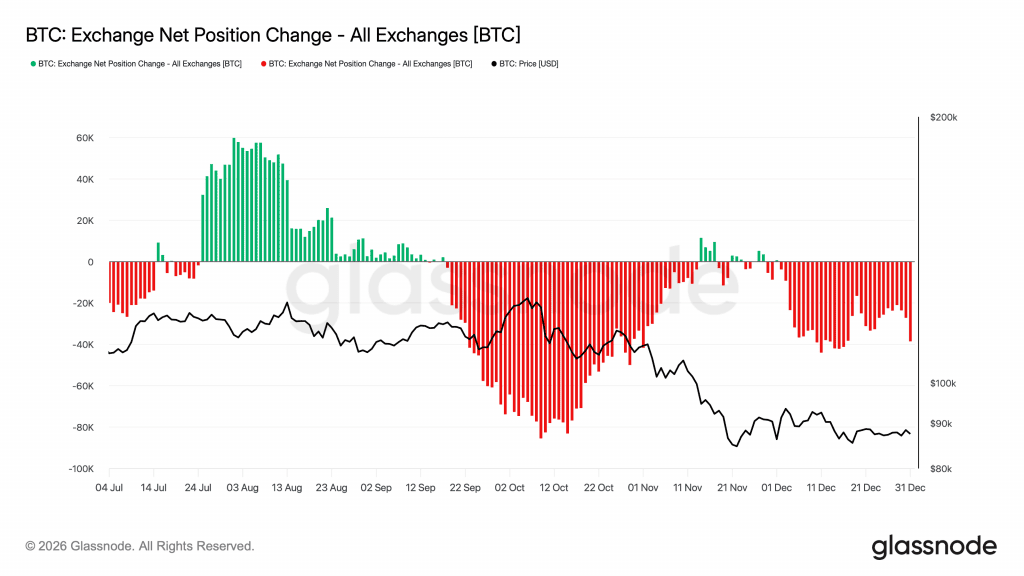
Exactly this second picture has been increasingly evident since the beginning of December 2025.A continuous net outflow of Bitcoin from exchanges has been observed over several weeks.Investors currently seem to show little willingness to sell and are positioning themselves more for the long term.Historically, this behavior is considered constructive because it reduces the immediately tradable supply.
The timing is particularly relevant: the outflows begin after a weak annual result and indicate that many market participants interpret the price levels more as an accumulation zone.This shows a cautiously positive outlook for 2026, even if it alone does not guarantee a new upward trend.
Bitcoin: Valuation drop opens up countercyclical opportunities
The On-chain metric Bitcoin Percent Supply in Profit meanwhile shows what proportion of the circulating Bitcoin supply is currently above the respective purchase price.Around the all-time high in October 2025, this indicator reached values close to 100 percent - practically every Bitcoin held was in profit at that time.Historically, such extreme values often mark overheated market phases.Accordingly, a clear correction movement followed, which was not only reflected in the price but also clearly in this key figure.
The proportion of profitable offers is currently around 65 percent, which is the lowest level in around two years. In previous cycles, declines below the 50 percent mark were even observed, so a further correction remains fundamentally possible.
At the same time, the current level signals that a large part of the speculative overvaluation has already been reduced.From a valuation perspective, Bitcoin is once again in a zone that has historically become increasingly interesting for long-term investors.

Even if further weakness cannot be ruled out in the short term, precisely such constellations could form the breeding ground for the first countercyclical strategies and gradual accumulation.
Crypto tip: Bitcoin Layer-2 as a potential price driver for 2026
With a view to 2026, technological developments that go beyond classic supply-demand models are also moving more into focus.A central topic is the further development of Bitcoin Layer 2 technologies.The aim of these approaches is to functionally expand the Bitcoin network without endangering its security or decentralization.Faster transactions, significantly lower fees and new use cases or programmable financial products could make Bitcoin more widely usable for the first time.This would mean that Bitcoin would not only be perceived as a store of value, but also increasingly as a productive infrastructure.If Layer 2 solutions succeed in attracting real-world usage and developer activity, this could create new structural demand for Bitcoin.
Direct to the Bitcoin Hyper Presale
Bitcoin Layer 2 solutions are increasingly seen as one of the most exciting developments in the crypto market.This is exactly where Bitcoin Hyper comes in.While Bitcoin has been established for years primarily as a digital store of value, new scaling approaches are now making it possible for the first time to create additional usage layers without compromising the security of the Bitcoin network.
Bitcoin Hyper positions itself as an extension of Bitcoin.The mainnet remains the final billing layer, while the Layer 2 structure provides a high-performance environment for applications.This allows known limitations such as slow transactions, low throughput rates and comparatively high fees to be addressed without compromising on decentralization or security.The approach aims to further integrate Bitcoin into areas such as programmable payments, decentralized finance applications and scalable settlement processes.
Other articles

5 Things to Know Before the Stock Market Opens
Stock futures are pointing to a higher open Thursday amid a chip stock rally, while investors also

Vexl: Empowering Peer-to-Peer Bitcoin Exchange Through Social Networks
In an era where centralized exchanges dominate cryptocurrency trading, Vexl stands out as a

The head of the Czech central bank urged not to equate Bitcoin with other crypto assets
Ales Michl published his opinion on Bitcoin amid the LIBRA scandal. The head of the CNB believes

The Bitcoin Pi Cycle Top Indicator: How to Accurately Time Market Cycle Peaks
The Bitcoin Pi Cycle Top Indicator has gained legendary status in the Bitcoin community for its